




Register to get 1 free article
Reveal the article below by registering for our email newsletter.
Want unlimited access? View Plans
Already have an account? Sign in
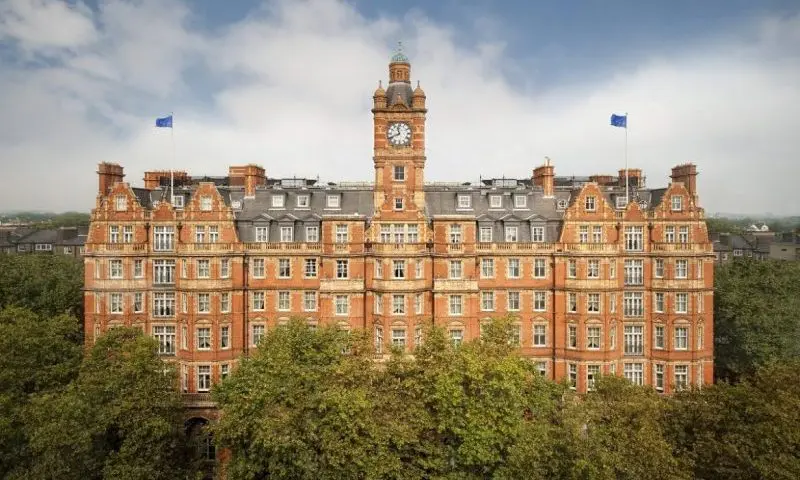
The Landmark London Hotel is now the only hotel in the world to be awarded a Platinum level accreditation from organisation accreditation firm Investors in People (IIP). It’s a historic moment in the property’s 18-year journey with the ‘Community Interest Company’, which has culminated in this prestigious accolade.
The assessment process involved an initial context meeting where the Landmark set out its goals for the Platinum accreditation process, followed by an online assessment where 92% of employees answered a survey about their experience of working there. The next stage of the process was on-site observation where an IIP practitioner sat in on morning meetings and held interviews with 39 staff members. Charlotte Smith, PR executive at IIP, says the Platinum award is the “highest accolade that IIP can award”. “It is reserved for the best companies who demonstrate truly out performing people management practices.” She notes only “1% of Investors in People accredited organisations have reached Platinum level”.
Additionally, the property was awarded the “highly coveted” Dale Carnegie Leadership Development Award, which recognised the hotel’s executive team’s ongoing success in “empowering, developing and instilling clear values” that enable the team to deliver the best “possible results and achieve their goals”. So how did the hotel achieve such rare success? Hotel Owner visited the property to get a flavour of the formula that caught IIP’s eye.
ENTERING THE LANDMARK LONDON
In the first few steps into the hotel, located just outside of city’s iconic Marylebone station, I am greeted by an impeccably presented grand entrance hall with staff at the ready to greet me. I was directed to the ‘Winter Garden’, a main area with a restaurant and bar teeming with guests at lunch. The space was designed to give the interior of the hotel an ‘outside-on-the inside’ look, I am told, featuring giant palm trees and a glass roof which bathed the hall in abundant natural light.
Here I meet with my hotel guide, Malina Apostu, who showed me around the rest of the property. On my journey through the winding corridors and expansive halls I am met with smiles and an unmistakable sense of professionalism and warmth from each of the staff members I encounter. For me, this seems just a small taste of the offering guests would receive when staying at the property.
ACHIEVING PLATINUM
Upon meeting Batchelor the very first question I ask was the feeling he got when he and the team achieved the accolade. He says it was “one of great pride”, and adds: “We are very delighted and pleased that the Landmark has been recognised by the Investor in People and with the platinum accreditation”. He notes that it has been a “long but rewarding journey”, and says in order to achieve the accreditation it all comes down to the staff at the hotel, as well as “looking at how the leadership engaged with them”. “The assessment is really a level of engagement in the hotel, that discretionary commitment over and above the job description,” he says, “so the assessor was looking at indicators that would reflect the level of engagement. Those indicators are leadership, reward and recognition, living to the values of the organisation, training and development.”
The staff took part in engagement surveys, which were then cross referenced by Forshaw to provide evidence for all that the assessor learnt while they stayed at the hotel. “The assessor was here for a week,” Batchelor adds, “and it was not down to luck or good fortune as to why we received the award, it was only the result of best practice”.
Along with the rest of the staff based at the Landmark, both Batchelor and Forshaw were integral to process of achieving Platinum level accreditation. In terms of their history in the industry, Batchelor has only have only ever worked in London, in four or five star hotels and for only for three companies in his whole life. His career started with the Savoy company when he left school, where trained and went to college at the same time at Oxford Brookes. He then joined Intercontinental Hotels, but headed back to Savoy to head up events with the company in the late 1980s. He then came over to the Landmark’s sister property, the Royal Lancaster, in 1989. He says his current owner bought the Lancaster in 1984 and then “inherited me as food and beverages manager”, culminating in Batchelor moving to the Landmark London in 2012 as hotel manager and then in 2013 becoming GM.
Forshaw on the other hand originally trained to be a chef, but decided “quite quickly” she did not want to pursue the career. She has been in the industry for over 22 years, starting initially on a graduate programme with Thistle Hotels, and working her up in operational roles and HR roles through the brand. She says she came to the Landmark to really “focus on employee engagement”. Forshaws says the key to successfully engaging with staff is about being “very open, honest and transparent in what we do and how we manage the team.” She adds that it is also about “encouraging our teams to really come out of their comfort zones often as possible”, which she notes help to “challenge what we do, but also challenge ourselves as individuals”.
She explains how the senior team have shown “a lot of energy around the initiatives” that the hotel organises. “We are very much into leading by example,” she says, “so for a lot of the training sessions that we do, the senior team will all do them first before we roll them out throughout the hotel.” She says that when the Landmark is raising money for charity, by hosting a bake off for example, Batchelor will also bake a cake and bring it in “just the same as everyone else”.
Another example Batchelor points out in the group’s ‘recipe for success’ is its system of ‘going back to the floor’. He says: “The senior team go back to the main floor for around three hours to do a floor shift. So Nicola might be serving food in uniform, and I might be a doorman”. He says this system “gets us closer to our team”, and through that the senior staff are able to give feedback to those areas. “When we do ‘back to the floor’, we can identify the areas that could be improved, such as staff needing more equipment or their uniform changing,” he adds. “So the senior team member who has done that shift can then follow up and make sure it’s done and implemented into the business immediately.” Forshaw adds: “There is a core of 10 of us that do ‘back to the floor’, but we also have other managers that join us as well. So in a day there are so many things that get improved within that three-hour block. The team can see that we are very into this continuous improvement and when we can we will do it pretty instantly.”
Even though the Platinum result has been a huge achievement, both say they are “already looking forward at what we need to do next”. “We never settle for where we are and we are always looking at that next step,” Forshaw says. “We are definitely not a culture that micromanages, and we like to give people space to be creative and try things.”
GOING THE EXTRA MILE
While at the Landmark I had the opportunity of speaking with Richard Kimbowa, a senior staff member who has been with the hotel for over 25 years. He started at the property in housekeeping in January 1993, and at the time didn’t think he would stay for very long. “I had planned to only work for a few years and then move onto something different,” he says, “but now I am the assistant head concierge”.
He says over the years he has built up a “strong relationship” with many of his guests, who know him personally now and come to him with specific requests. A lot of repeat guests are VIPs from the Middle East, and he recalls a time when one of his clients wanted to take his family to the World Cup in Russia. He came to Kimbowa specifically to organise the trip, who was able to get tickets for the event, set up the hotel and even organised transport.
Another example of Kimbowa going the extra mile for his guests was when one of his clients wanted to book football tickets for his children to watch a game in Manchester on their own. He says getting the tickets “wasn’t a problem, but the real issue was getting them to the game”. The children were quite young, between 12 and 15, and he says letting them taking public transport on their own “wouldn’t be ideal”. Richard ended up offering to book a coach for the children and escorted them personally to game and then back, even though it was his day off. Going even further, Richard arranged for one of the players to meet the children, which he says they were “delighted with”.
As a result Kimbowa says he often gets a lot of positive comments from the guests he has helped, a reflection of the tireless work he dedicates to them, and is even mentioned by name in many Tripadvisor reviews of the property. He says this is an “amazing feeling”, and to see the satisfaction from guests is a “great achievement”. He concludes by saying the Landmark is an amazing place to work and that the relationship between all staff is like that of a “family”.
FINAL THOUGHTS
After achieving the highest possible award from a business accreditation firm the real question becomes where to go next. Batchelor says the hotel must “never get get complacent”, and his plan going forward to is “to maintain consistency and to make sure we maintain our high standard”. “It is important that we continually reassess everything that we do to maintain the IIP platinum accolade and to ensure that our guests continuously made to feel special at every opportunity.”
This article first appeared in the November 2018 issue of Hotel Owner