








































Register to get 3 free articles
Register to unlock the article and receive our free newsletter. Join 26,000 other hotel leaders and stay in the know.
Want unlimited access? View Plans
Already have an account? Sign in
The latest fire figures record 22,200 fires in buildings that were not dwellings. The majority of these occurred in shops, food outlets and factories. In total, 17 fatal and 1,083 non-fatal casualties occurred in these fires.
Although hotels fall under this grouping, they have a relatively low occurrence of fires because they are covered in the category of buildings in which people sleep and therefore an automatic fire detection (AFD) and alarm system is normally considered necessary. AFD systems can vary from small simple systems with one or two manual call points and sounders to systems which incorporate a large number of automatic fire detectors, manual call points and sounders connected to numerous intercommunicating control and indicating panels.
An appropriate AFD system – dictated by British Standard BS 5839-1 which covers the design, installation, commissioning and maintenance of systems in both new-build and existing non-domestic premises – will warn everyone in the building of a potential fire at the earliest opportunity so that they can evacuate it, and also alert the Fire Brigade.
AFD systems save lives, there’s no doubt about it. However, the issue of false alarms in such systems is a major problem.
WHAT IS A FALSE ALARM?
A false alarm is defined as an event in which the Fire & Rescue Service believes they are called to a reportable fire and then find there is no such incident.
False alarms take up valuable resources of Fire & Rescue Services, made all the worse because of the 30% cut to their funding during the course of the last parliament and the subsequent loss of nearly 7,000 frontline jobs. For the hotelier, it is also a waste of their resources and has a negative impact on customer experience; no one wants to be woken up in the middle of the night and have to evacuate the hotel in their pyjamas!
Minimising the number of false alarms is therefore a top priority for all concerned. AFD systems can be designed to include sophisticated techniques to avoid false alarms, but the detectors themselves also have a role to play.
DETECTOR TYPES
The choice of detector for a particular building is governed by three key considerations: the speed of detection/response required; the need to minimise false alarms; and the nature of the fire hazard.
Sensors contained within fire detectors are designed to detect different aspects of a fire; these are heat, smoke, combustion gas (most notably carbon monoxide) and infrared and/or ultraviolet radiation from the flames. Each has its pros and cons in terms of what types of fire it detects, where it can be used and what can possibly cause it to false alarm.
There is no one type of fire detector that is suitable for all applications, so every system will require a mixture. However, regardless of the alarm types chosen, they must conform to relevant British Standards and have undergone type testing to these standards, preferably certified under a recognised third-party product certification scheme.
WHAT CAUSES FALSE ALARMS?
There are a variety of reasons why AFD systems can false alarm, with one of the most common being the selection of an inappropriate alarm type for a specific location. One major culprit here is in the guest bedroom.
Best practice and relevant standards dictate that smoke detectors should never be fitted in kitchens or bathrooms. This is because these environments generate steam and cooking vapours which can be ‘misread’ as smoke by detectors. In a kitchen you would use a heat alarm instead. In a bathroom you would not use an alarm.
This becomes problematic in a hotel as you must have an alarm in each bedroom, but the en suite bathroom is in very close proximity. A guest who has enjoyed a long hot shower or bath lets the steam into the bedroom as soon as they open the bathroom door. This situation is compounded by the fact that the alarm needs to be close to the main door for safety reasons – which is also where you most often find the bathroom door.
PREVENTING FALSE ALARMS FROM STEAM
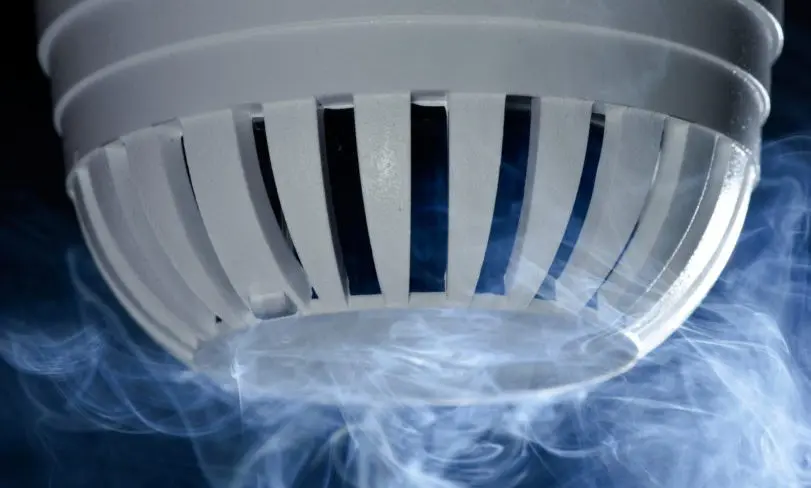
Generally speaking, the infrared scattered light technology currently used for commercial smoke detectors is unable to distinguish between larger size particles like steam or dust, that are major causes of false alarms, and particles generated by combustion (fire).
One solution is to move the detector further away from the bathroom, but this could compromise safety as it is also further away from the escape route. There is also a not inconsiderable cost element to this solution for existing hotels, from requiring an installer to move the devices and cables to having to redecorate afterwards to cover up where the alarms had been previously; not to mention the disruption and loss of earnings. And there is still no guarantee that the steam would not affect these devices in the new location.
A further option is to use a multi-sensor.Unlike single sensor based detectors, a multi-sensor combines two sensing elements, usually optical and heat. It interprets the signals from both sensors to get a better understanding of what’s really happening in the immediate environment. Due to this, it benefits from a quick response to both slow smouldering and fast flaming fires yet has greater immunity to false alarms. It’s a better option, but ‘greater immunity’ may not be good enough; multi-sensors are still somewhat susceptible to false alarms caused by dust and steam.
A multi-sensor is based on the principle of ‘two is better than one’. The other detector-based solution open to you uses the same principle but in a different way. Dual optical alarms use a single sensor type – optical, which ‘looks’ for smoke using a scattered light beam in the sensing chamber. However, instead of just using the standard infrared light, it also employs blue LEDs to provide a more accurate measurement of particles within the chamber. By calculating the ratio of these light sources, which operate at different wavelengths, the detector can determine the particle size and thus distinguish between smoke and non-combustion products such as steam and dust. It reduces false alarms caused by steam, but the detector remains sensitive to combustion products to generate an alarm.
Fire detection and alarm systems are absolutely essential, but you don’t have to put up with false alarms and neither do guests. If you have a fire detection system that is causing disruption to your business as a result of false alarms, take action and talk to your installer to discuss the options. False alarms, especially from steam, don’t have to be a headache.
The Cliff Hotel & Spa in Cardigan, West Wales is a good example of the issue of false alarms caused by steam. A large family-owned hotel, the Cliff Hotel features 70 en-suite bedrooms, spa and gym facilities, function suite and a golf course. The hotel had been experiencing a number of issues of false alarms, primarily caused by steam escaping from the en-suite bathrooms and activating the smoke alarms. The installer, Fire and Security Alarms Ltd., was familiar with the problem and replaced the existing alarm system with a Nittan Evolution system including over 200 EV-DP dual optical smoke detectors. The new alarms have prevented further false alarm issues for the hotel.
Lee James is general manager of sales and Marketing, Nittan Europe. This feature first appeared in the April 2016 feature issue of Hotel Owner.