
















Register to get 3 free articles
Register to unlock the article and receive our free newsletter. Join 26,000 other hotel leaders and stay in the know.
Want unlimited access? View Plans
Already have an account? Sign in
The Nitenite hotel was first established some 10 years ago, with the redevelopment of an old, unused carpark in Birmingham into a compact – yet luxury – hotel offering. With each room space at the original site measuring at a mere 7.8 square metres, Fiveways Hospitality launched the second generation with a larger dwelling space of 10.6 square metres three years after acquiring the company.
Gaining recognition as possibly the first windowless hotel in the UK, Fiveways Hospitality is hoping to sell the concept as a franchise and see the Nitenite brand spread far and wide across the country. Targeting city centres, Atkinson sees the Nitenite hotels as emulating a “luxury yacht feel”, where the focus is on the guest exploring their surroundings rather than spending their whole holiday in their hotel room. With 39 years in the hotel industry, Atkinson claims to have spotted a change in the way hotel rooms are used, saying: “People are not using restaurants in hotels anymore, [they] want choice for where to eat and drink.” He adds, “[They] usually want an overnight stay or two, they’re not there for the hotel bedroom; they’re there for the city break or business.”
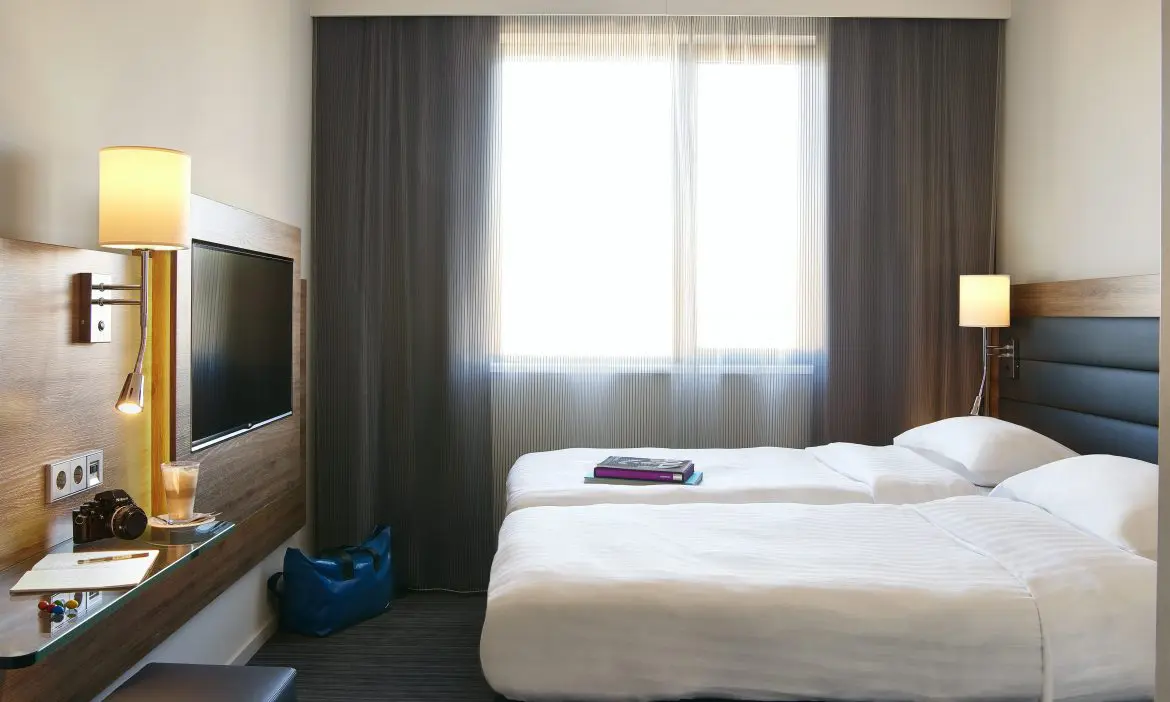
Despite his prediction that people no longer want to spend the majority of their time in their hotel rooms, Atkinson ensures that this belief doesn’t have to strip guests of their travel essentials. Each Nitenite room has a double bed, 42-inch television, full electronic controls, lighting, heating, free Wi-Fi, desks and “plenty of mirrors”. Research has even gone into the room’s blow-drying station to check whether long-haired guests are able to get ready with ease and ample space. Each room also has an en-suite with the option of a fully glazed double rainwater shower or an accessible shower for the customers who require it.
Its design means that each site has roughly 35-40% more room stock than a typical Premier Inn property and the hotel has no public or eating areas, as locations are perfectly sought out to make sure that food outlets are easily accessible and guests can fully experience the city they’re in. However, there are possible plans to create future properties with workspaces – a potential capitalisation on the brand’s existing business clientele.
The rooms have been satisfactory for guests with Atkinson stating that there haven’t been any outstanding complaints so far. “We might have had a few people say they don’t like it, to be fair, but we’ve never had anybody come running and screaming out the room saying: ‘I feel really honed in!’” The second generation of the hotel hopes to remedy this not only with a slightly larger room but also with the installation of a graphic LED panel in place of a window – to invoke “a real feel of comfort” and make the area feel less small.
With the expansion of the brand underway, Atkinson has cities such as London, Edinburgh, Nottingham, and Cambridge as the few in mind he wants to take the concept to next. Seeing the concept as “relatively limitless”, Aktinson also sees the possibility of having sites at airports and opening ‘work and stay’ areas.
Claiming that the hotel will benefit whatever city it goes to, he goes on to suggest that whoever decides to take on the franchise will have a good deal on their hands. With Fiveways offering management services on the prospective investors’ behalf, Atkinson states that it would be a “good return investment.”
This article first appeared in the September 2017 issue of Hotel Owner