










Register to get 3 free articles
Register to unlock the article and receive our free newsletter. Join 26,000 other hotel leaders and stay in the know.
Want unlimited access? View Plans
Already have an account? Sign in
Can you tell me about yourself and your experience in the hospitality industry?
I’ve been in the hospitality industry since the age of 26. I first started working for Louvre hotels in Paris in a regional operations role, where I spent 16 years and ended up with a portfolio of about 110 hotels as regional vice president for Northern Europe for them. I then left them to go and head up as managing director for Dolce Hotels and Resorts in Europe, where we had one upper-upscale and four five-star hotel outside of every international airport in Europe, and we were focused on 60% meetings, incentives, conferences, and exhibitions (MICE) and 40% leisure.
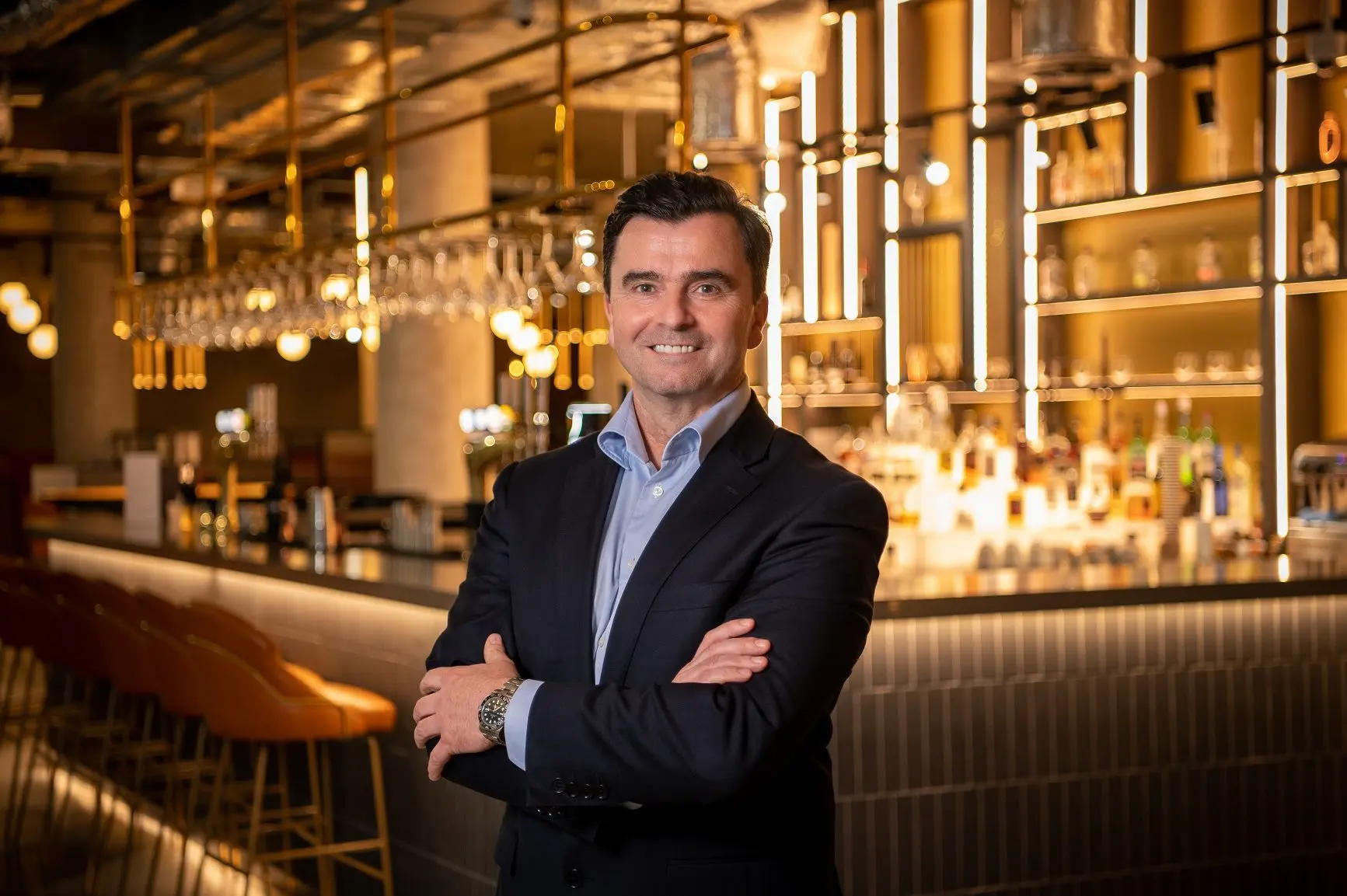
After spending four years with Dolce, I was then appointed CEO of Sun Resorts, which was a luxury resort company based in Mauritius. We had beautiful resorts in Mauritius and the Maldives, and we also owned the Four Seasons and Shangri-La in Mauritius. So, I came away from a MICE experience with Dolce and then went straight to a luxury resort. It’s been 18 months now since I joined Aimbridge, where I am currently divisional president, looking after about 120 odd hotels across EMEA.
Can you tell me about the history of Interstate Hotels and Resorts and its rebranding to Aimbridge EMEA?
Interstate was the first third-party management company in the world. It was founded in 1960, at the same time as the big global American brands. Interstate Hotels then came over from the US to Europe in 1995, where we had nine hotels in Moscow, and we were in Russia for a long time. Obviously, we had to come out of Russia last year and on July 7. But by being in Russia, we were then able to acquire Chardon Hotels and Sanguine Hotel Group in the UK in 2013 and immediately became the largest third-party hotel operator in the UK.
Following that, in 2019, the third-largest private equity group in the world acquired Aimbridge and then, in the same year, Interstate, resulting in the creation of the largest third-party hotel group in the world. In October of last year, Interstate, which was always the international division for Aimbridge, adopted the name Aimbridge. We work for the same company anyway; we just felt that it was a natural development and that it was the right time to move away from the Interstate name and opt for Aimbridge to be one global company.
What led the company to change its name to Aimbridge EMEA?
What we understood was that all the investment in the brand was made in Aimbridge. It was the new mothership, and so we felt that if we could also adopt the name Aimbridge, we would then be one global company to the world.
Additionally, a lot of our hotel owners with Aimbridge in the US were also interested in investing in Europe and EMEA, and therefore, we thought it would just help to have one name and one company for our external owners as well as for recruitment at Aimbridge. We also decided to rebrand to maximise the benefits of scale and investment in the brand. I believe it was always going to be a natural development for Interstate to flip to Aimbridge and enjoy those benefits.
Did you face any challenges during this process and how did you overcome them?
Some of our owners, hotel partners, and brands were obviously curious as to why we were rebranding because they had known Interstate for the last 10 years. But when we explained the reason behind the rebranding, they understood. Since we are a B2B brand, we had to conduct significant external communication that was really focused on the industry. As a result, we explained the reasoning behind the name change at our hotel conferences, and we catered to any concerns that they may have had. Once we had agreed on the rebranding of Interstate, it took us roughly six months from start to finish to complete the rebranding, and it has been seamless so far.
How is the company faring after the rebranding?
One of my goals was to increase our presence in Europe, continental Europe, and Eastern Europe. Now when we look at our development pipeline, we can see that we have a huge surge in opportunities in these areas. Though these deals are at an early stage across Iberia, Italy, and Germany, it’s a really exciting focus for us. Additionally, Interstate was also not present in Spain or Germany, after the rebranding it became easier to enter the market with Aimbridge because of the benefits of scale, our complete emphasis on operations, and the extremely tight relationships that we have with our owners.
We have also got a larger potential deal space since the merger, and we have also been able to really harness the benefits of all what we call proprietary tools that were developed in Aimbridge across financial, commercial and procurement platforms. For example, we are now able to enjoy the best purchase procurement rates in the market across EMEA, as suggested by our suppliers.
What big changes have you seen between when you first entered the hospitality industry and now?
Talking from an investor’s point of view, in the last five or six years, there’s been a real surge of private equity groups looking at investing in the hotel asset class, and that has driven a lot of the dynamics into new countries and into new portfolios. It has made it possible for those portfolios to be upgraded very quickly since, normally, a private equity organisation will buy a portfolio, swiftly assess its value, and then sell it. So from an investor’s perspective, that has been a significant change.
In terms of lifestyle, hotels have gone through an incredible journey. It’s been amazing to see how the lifestyle sector of the hospitality industry has evolved, from boutique hotels to lifestyle hotels, wellness, spa experiences, and culinary. I’d add that there has been a noticeable improvement in gastronomic experiences all around the world.
What trends are you seeing currently in the hospitality industry?
I would say that there are now more opportunities across Europe for brands that were traditionally operated domestically. For example, in Spain, it was traditionally Meliora, Barcelo, and NH hotels, but in the last five years, there has now been a huge level of interest from foreign capital. When foreign capital comes in, they then look to work with the big global brands. So, I think there has been an increase in international brands in what were traditionally domestically branded markets. Especially countries such as Italy and Greece, which were traditionally very family-oriented hotel operations, have attracted a lot of foreign capital coming in, whether it is in the form of conversions, renovations, or new projects.
I would also say that investors have recently started looking at resorts. Previously, they wouldn’t consider looking at resorts. But as they get more and more experience in the hospitality world, they realise that the seasonality of resorts can always be extended.
What are Aimbridge’s growth plans for Europe?
Starting with the UK, we’re already the largest third-party operator in the UK, and we have about 75–80 hotels in the region. In the last six months, we have transitioned seven new hotels, and it takes us anywhere from four to six weeks to fully transition a hotel into our systems and get it on the map. We consider that to be very essential and want to keep doing it. Organically, we are working with a lot of our existing owners in the UK to help them grow their hotel portfolios.
We now run a little more than 15 hotels in the Benelux region of continental Europe, and we’re trying to increase that number. Additionally, we hope to expand our business in Italy, Iberia, Spain, Germany, Austria, Switzerland, and many more countries. So, if we look at our pipeline, there are several opportunities that are coming up.
Where does Aimbridge EMEA envision itself in five years?
We are looking to double our portfolio in the next five years, and I would like to see that across the countries I mentioned. We are also keeping a very close eye on the UAE. Recently, we have been noticing a lot of dynamic hotel activity there. So that is also in our pipeline.